From time to time, Morningstar publishes articles from third-party contributors under the "Perspectives" banner.
Here, Arjun Parthasarathy of www.investorsareidiots.com, a financial website for investors, writes about how fixed-income investors can profit from falling inflation.
If you are interested in Morningstar featuring your content, please find further details here.
Inflation for the month of January 2012 came in at 6.55%, a 26-month low. For the last two years, fixed-income investors have been extremely risk-averse on rising inflation fears and have invested in products such as fixed deposits, fixed maturity plans (FMPs), government-run saving schemes and corporate non-convertible debentures (NCDs).
Inflation has been trending at over 9% levels for the most of last year and unless investors earned post-tax returns of 9% and above, they would have been earning negative real returns on their investments.
Household inflation rate has been much higher than official inflation estimates and investors' fixed-income investments must have been earning high real negative returns for the last couple of years.
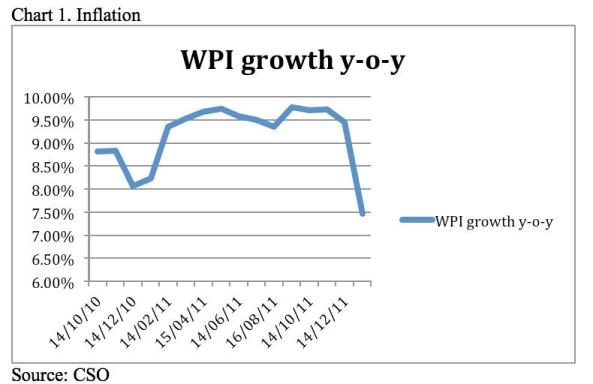
Now with inflation coming off, investors can hope to earn real positive returns on their investments. Inflation is expected to stay at below 7% levels for a few months as per the country’s economic advisor.
Investors target for post tax returns for the next couple of years should be over 7%, assuming that inflation stays at below 7% levels.
The market levels of yields for various fixed income instruments are much higher than inflation at present. One-, five- and 10-year government bonds yield 8.7%. 8.35% and 8.37%, respectively, on an annualized basis. One-, five- and 10-year AAA corporate bonds yield 9.9%, 9.3% and 9.2%, respectively. Lower-rated corporate bonds yield well above 10%.
The traded levels on various fixed-income securities are attractive given inflation at below 7%.
The reason market levels of fixed income securities are still trading higher than inflation is due to a) liquidity b) the Reserve Bank of India's (RBI) policy rates and c) government borrowing.
Liquidity is tight in the system with banks borrowing over Rs 1,50,000 crore from RBI on a daily basis. The banks borrowing cost is the RBI policy rate--the repo rate--which is at 8.5%.
Government finances are not healthy and hence government is borrowing heavily from the market leading to government bond yields staying at higher levels.
Going forward, April is traditionally a month where liquidity is positive in the system as March-end liquidity pressures wear off and banks have excess cash, as lending is usually slow in the beginning of a fresh fiscal year.
The RBI in the meanwhile is likely to cut policy rates of cash reserve ratio (CRR) and repo given inflation staying below 7%. The traded yields are likely to fall in fixed-income securities in the coming weeks.
Investors have two choices a) lock into higher yields by investing in fixed deposits, FMPSs and NCDs or b) capture the falling yields and earn capital gains by investing in short-term and long-term mutual fund schemes.
High net-worth investors should take the portfolio-management services route to invest in traded securities.
There is always a risk that if inflation goes up, the RBI will not cut rates and the government may not be able control its finances.
However given that the market rates are well above the inflation rate of 6.5%, there is a natural protection to investors even if risk factors rear up.