Investor sentiment in March 2026 was shaped by a combination of heightened geopolitical uncertainty, intermittent volatility in equity markets, and evolving global interest rate expectations. Escalating tensions in the Middle East—stemming from the conflict involving the United States and Israel on one side and Iran on the other—triggered bouts of risk aversion across global markets and contributed to a correction in Indian equities during the month. In March, while BSE Sensex fell by 11.5%, BSE Midcap was down 11.2% and BSE Smallcap plunged by 10.9%.
Despite this volatility, domestic investors largely viewed the market decline as a buying opportunity. At the same time, uncertainty around the global interest rate trajectory and inflation outlook kept investors cautious on duration within fixed income, leading to a preference for shorter-maturity and liquidity-oriented debt strategies.
Gold, meanwhile, continued to attract investor attention as a safe-haven asset amid geopolitical tensions and currency volatility, reinforcing its role as a portfolio diversifier.
Against this backdrop, lets evaluate the flow trend in mutual fund across the segments in the month of March.
Equity-Oriented Categories Witness Robust Flows
Equity-oriented mutual fund categories recorded net inflows of INR 40,450 crore in March 2026, a sharp increase from INR 25,978 crore in February, indicating a strong pickup in investor participation toward the end of the financial year. This was the highest monthly inflow since July 2025, when equity-oriented mutual funds had received net inflows of INR 42,702 crore.
The surge in flows reflects sustained retail participation through SIP contributions, year-end portfolio allocations, and investors deploying fresh capital during periods of recent market correction.
Indian equity markets witnessed a notable decline during the month amid heightened geopolitical tensions linked to the Middle East conflict. However, the volatility created attractive entry points for long-term investors, prompting many to increase allocations through mutual funds. As a result, the market correction was largely viewed as a buying opportunity rather than a trigger for risk aversion, leading to a meaningful pickup in equity inflows.
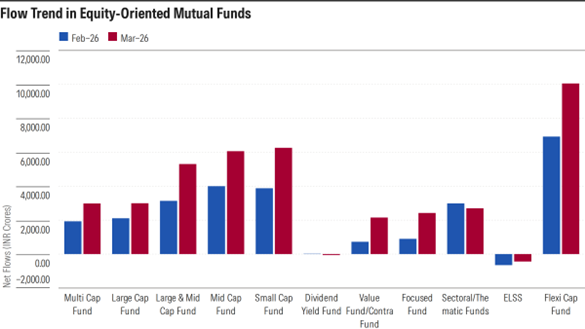
A key highlight of the month was the sharp acceleration in flows into mid-cap and small-cap categories. Mid-cap funds attracted inflows of about INR 6,064 crore, while small-cap funds saw inflows of around INR 6,264 crore, both registering a notable increase compared with February. The recent correction in these segments appears to have provided investors with an opportunity to add exposure at relatively reasonable valuations. The renewed interest in these segments suggests that investors remain constructive on the long-term earnings growth potential of mid- and small-sized companies. Additionally,
Large-cap funds also witnessed stronger traction, with inflows rising to about INR 2,998 crore in March, compared with INR 2,112 crore in February. This indicates a balanced allocation approach, where investors are increasing exposure to relatively stable and established businesses alongside growth-oriented segments, particularly amid an uncertain global macro backdrop.
Flexi-cap funds remained the largest contributor to overall inflows, attracting INR 10,054 crore during the month, significantly higher than the previous month. The category continues to benefit from investors’ preference for diversified strategies that provide flexibility to allocate across market capitalizations depending on valuation and opportunity.
Flows into large & mid-cap funds and focused funds also saw a sharp uptick, with inflows rising to INR 5,307 crore and INR 2,425 crore, respectively. This suggests that investors are increasingly willing to take selective exposure to strategies offering a blend of diversification and conviction-driven portfolio construction.
On the other hand, dividend yield funds and ELSS funds were the only categories to witness net outflows during the month.
New fund offer activity remained relatively moderate. Eight funds were launched during March, cumulatively garnering about INR 1,947 crore. Of these, one was a mid-cap fund, two were small-cap strategies, four belonged to the thematic category, and one was a flexi-cap fund.
Despite the strong inflows, the asset base of equity-oriented funds declined to INR 31.98 trillion at the end of March 2026, compared with INR 35.39 trillion in February, largely reflecting the impact of the recent market correction on portfolio valuations.
Overall, the March flow trend indicates that domestic investor participation in equities remains structurally strong. The sharp pickup in inflows suggests investors increasingly view market corrections as opportunities to add exposure and capitalize on attractive valuations.
Net Outflows Hit Debt-Oriented Categories
Debt mutual funds witnessed a sharp pullback in March 2026, with outflows across nearly all major categories. Open-ended income/debt-oriented schemes together recorded a net outflow of INR 294,987 crore during the month, marking a steep reversal from the relatively healthier flows seen in January and February.
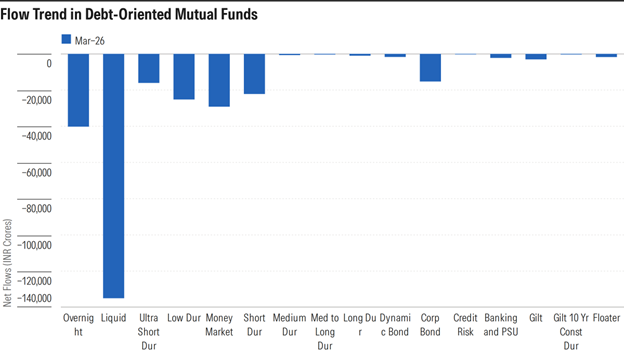
The pressure was largely concentrated in short-term and treasury-oriented categories, suggesting that quarter-end institutional and corporate liquidity adjustments were the primary driver behind the sharp withdrawals.
Liquid funds saw the largest outflows at INR 134,988 crore, followed by overnight funds with INR 40,228 crore, money market funds with INR 29,207 crore, and low-duration funds with INR 25,227 crore. The concentration of redemptions in these categories reinforces the view that treasury and institutional cash management activities played a significant role in the month’s weakness.
Beyond these segments, flows were also soft in a few other categories. Short-duration funds witnessed outflows of INR 22,194 crore, while corporate bond funds recorded redemptions of INR 15,293 crore, indicating some pressure even in relatively high-quality accrual-oriented strategies.
Gilt funds continued to see outflows, with about INR 3,078 crore exiting during the month, suggesting that investor appetite for duration-led strategies remained limited amid uncertainty around the global interest rate trajectory.
From a broader quarterly perspective, the sharp pullback in March was large enough to push overall debt fund flows into negative territory for Q1 2026, with short-term categories accounting for the majority of the weakness. Overall, the March data appears to reflect seasonal quarter-end liquidity adjustments rather than any broad-based deterioration in sentiment toward fixed income investments.
Gold ETFs Continue to Attract Investors
Gold exchange-traded funds (ETFs) continued to register net inflows in March 2026, though at a slower pace compared with the previous two months. The category recorded net inflows of INR 2,266 crore in March, compared with INR 5,255 crore in February and INR 24,040 crore in January.
While the pace of inflows moderated sequentially, investor interest in gold-backed products remained positive.
The slower inflows in March likely reflect a normalization after the unusually strong start to the year, along with some moderation in fresh allocations. January had witnessed exceptionally high inflows, likely supported by heightened risk aversion, portfolio rebalancing, and strong momentum in gold prices, making subsequent monthly numbers appear softer by comparison.
Nevertheless, the continued inflows in March suggest that gold retains its relevance as a portfolio diversifier amid market uncertainty and macro volatility. Gold ETFs remain particularly appealing because they offer a liquid, transparent, and convenient avenue for investors to gain exposure to the metal without the logistical challenges associated with holding physical gold.
From a broader perspective, gold ETF inflows for Q1 2026 stood at INR 31,561 crore, indicating that despite the month-on-month slowdown, the category has had a strong quarter overall. The trend suggests that investors continue to view gold both as a tactical hedge against uncertainty and a strategic allocation within diversified portfolios.