The first quarter of 2026 was a chastening one for India-focused offshore funds and ETFs. A confluence of global headwinds — geopolitical tensions in the Middle East, a resilient US dollar, elevated bond yields, and rising crude oil prices — combined with domestic concerns around stretched valuations to trigger a sharp withdrawal of foreign capital from Indian equity markets. The quarter ended March 2026 stands out as one of the most difficult periods for foreign investor sentiment toward India in recent years.
Flow Trends: The Worst Quarter in Six Years
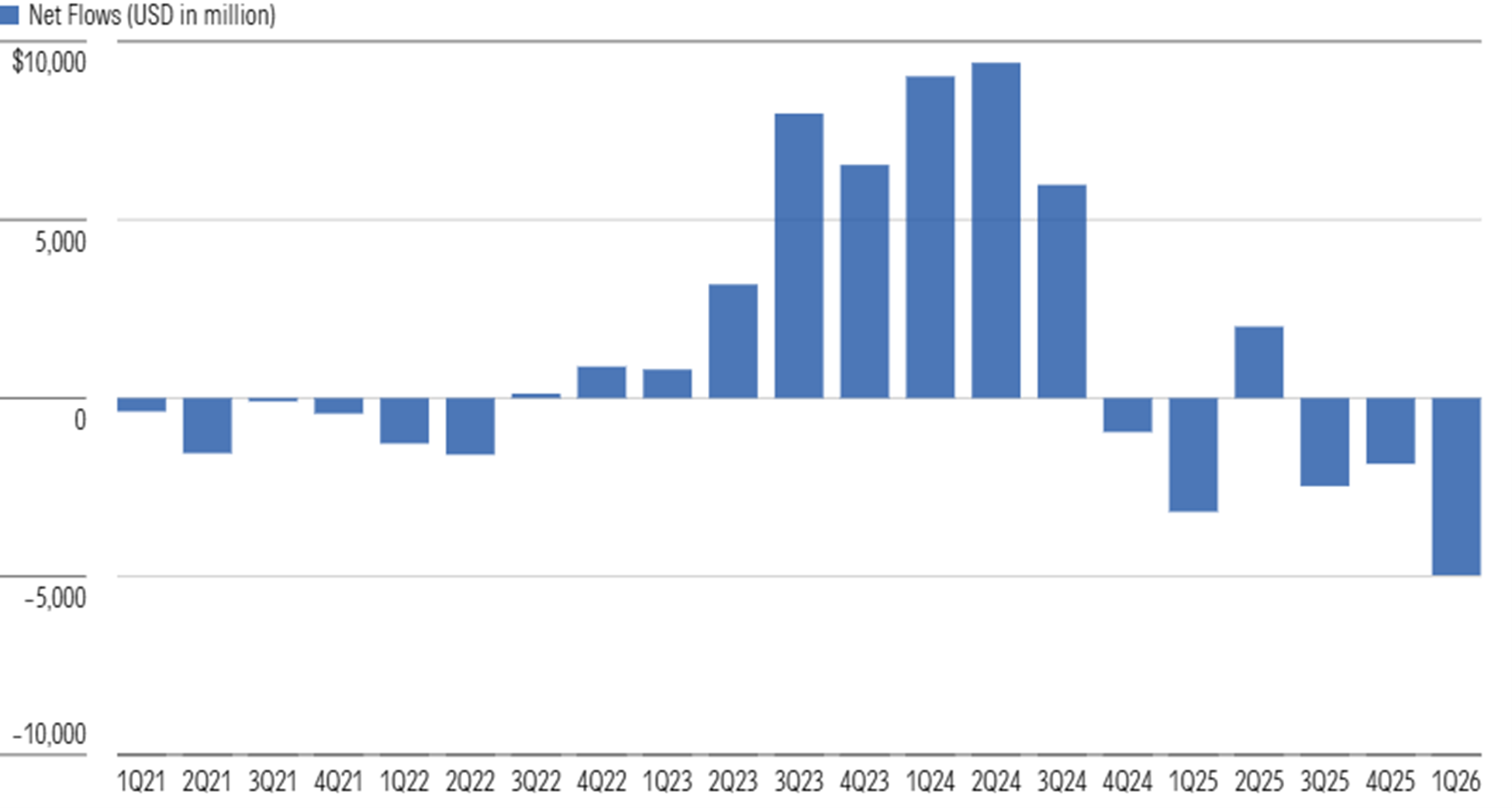
India-focused offshore funds and ETFs recorded net outflows of approximately USD 5 billion during the quarter ended March 2026 — a sharp deterioration from the USD 1.8 billion outflow seen in the preceding December 2025 quarter. To put that in context, the mutual fund component alone (excluding ETFs) saw its worst quarterly outflow since March 2020, the quarter that was roiled by the onset of the COVID-19 pandemic. Through the quarter ended March 2026, it recorded a net outflow of USD 3.46 billion. India-focused offshore ETFs also turned net sellers, with outflows of USD 1.50 billion, a stark reversal from the USD 552 million of net inflows it attracted in the previous quarter.
Exhibit 1 Quarterly Estimated Net Flows of India-Focused Offshore Funds and India-Focused Offshore ETFs (in USD Millions)
Source: Morningstar Direct. The quarters are for the calendar year. Data as of March 31, 2026.
On a cumulative one-year basis, the category has now witnessed net outflows of USD 7.54 billion, underscoring the cautious approach of foreign investors towards emerging markets like India.
The Drivers: Why Foreign Investors Stepped Back
The sell-off was not driven by any single factor but by a combination of both global and India-specific factors, though global risk aversion was probably the larger driver during the quarter. Globally, the environment turned extremely challenging for emerging markets – We had heightened geopolitical tensions in the Middle East involving the US, Israel, and Iran, a stronger US dollar, elevated US bond yields, and uncertainty around the timing of Fed rate cuts. All these factors reduced global risk appetite and led investors to move toward safer assets like US Treasuries and the dollar.
At the same time, India-specific factors also contributed. Indian equities were trading at relatively premium valuations compared with several emerging markets, especially in the mid- and small-cap segments. After the strong rally over the last few years, many foreign investors chose to book profits as earnings growth expectations moderated.
That said the recent net outflows are not a reflection of a loss of confidence in India’s long-term structural story. Rather, it was a phase where global risk-off sentiment coincided with valuation recalibration in Indian markets.
Asset Trends: A Sharp Erosion in the Category's Base
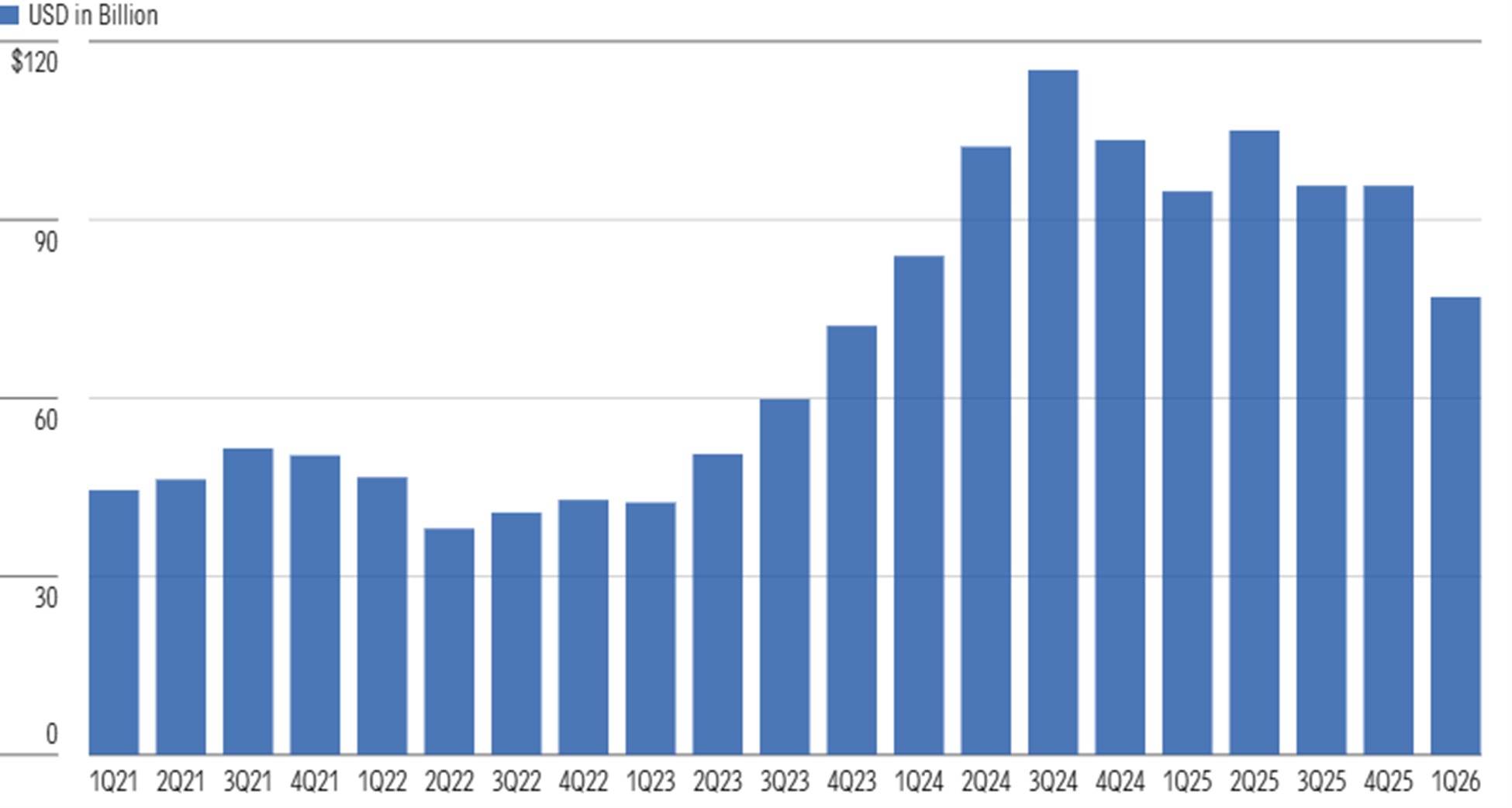
Net outflows, compounded by a broad-based correction in Indian equity markets, delivered a significant blow to the asset base of India-focused offshore funds and ETFs. The category's total assets fell sharply by 19.5% to USD 77 billion as of March 2026, from USD 96 billion at the end of December 2025.
Exhibit 2 Quarterly Net Assets of India-Focused Offshore Equity Funds and ETFs (in USD Billions)
Source: Morningstar Direct. Data as of March 31, 2026.
Within the category, India-focused offshore mutual funds declined from USD 66.2 billion to USD 52.9 billion, while India-focused offshore ETFs saw their assets shrink from USD 29.6 billion to USD 24.1 billion over the same period.
Performance: The Category Absorbs the Blow, Narrowly Beats the Benchmark
The Indian equity market correction was broad and sharp. The BSE Sensex fell 15.5% during the quarter, the BSE Midcap Index declined 13.6%, and the BSE Smallcap Index suffered the steepest fall at 16.1%, reflecting the elevated valuation risk in the smaller-cap segments.
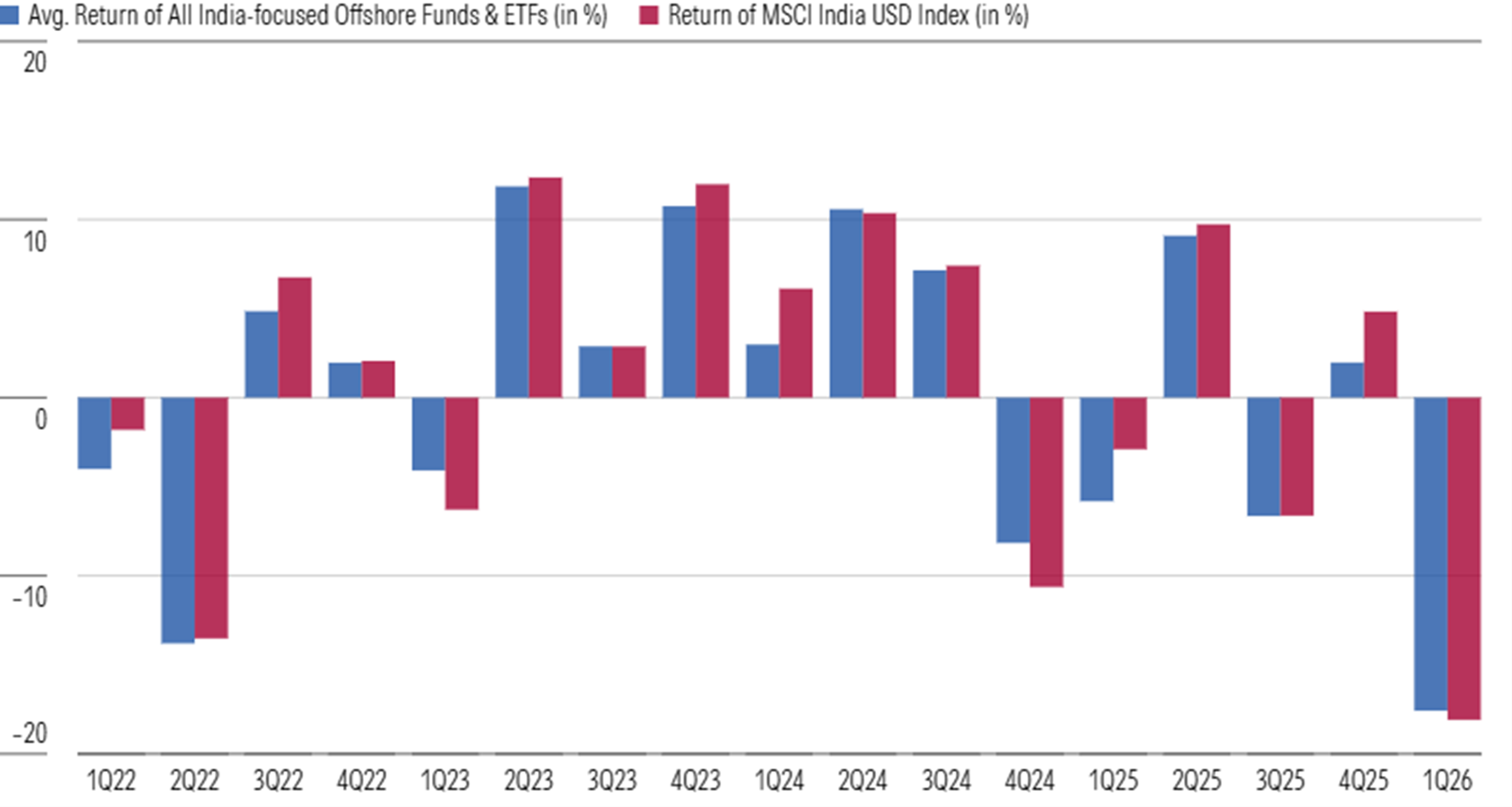
Exhibit 3 Quarterly Returns of India-Focused Offshore Funds and ETFs Versus the MSCI India Index
Source: Morningstar Direct. Returns are denominated in INR. Data as of March 31, 2026. Note: Past performance may or may not be maintained in the future and should not be used as a basis for comparison with other investments.
Against this backdrop, the India-focused offshore funds and ETF category fell 17.6% — a painful drop in absolute terms, but marginally better than the MSCI India USD Index, which delivered a negative return of 18.1% during the quarter. The outperformance, while narrow, suggests that active management provided a modest buffer — likely through higher large-cap and cash allocations, which proved resilient relative to the mid- and small-cap segments that bore the brunt of selling pressure. However, the category's longer-term performance record remains a concern.
The Regionally Diversified Segment: A More Nuanced Picture
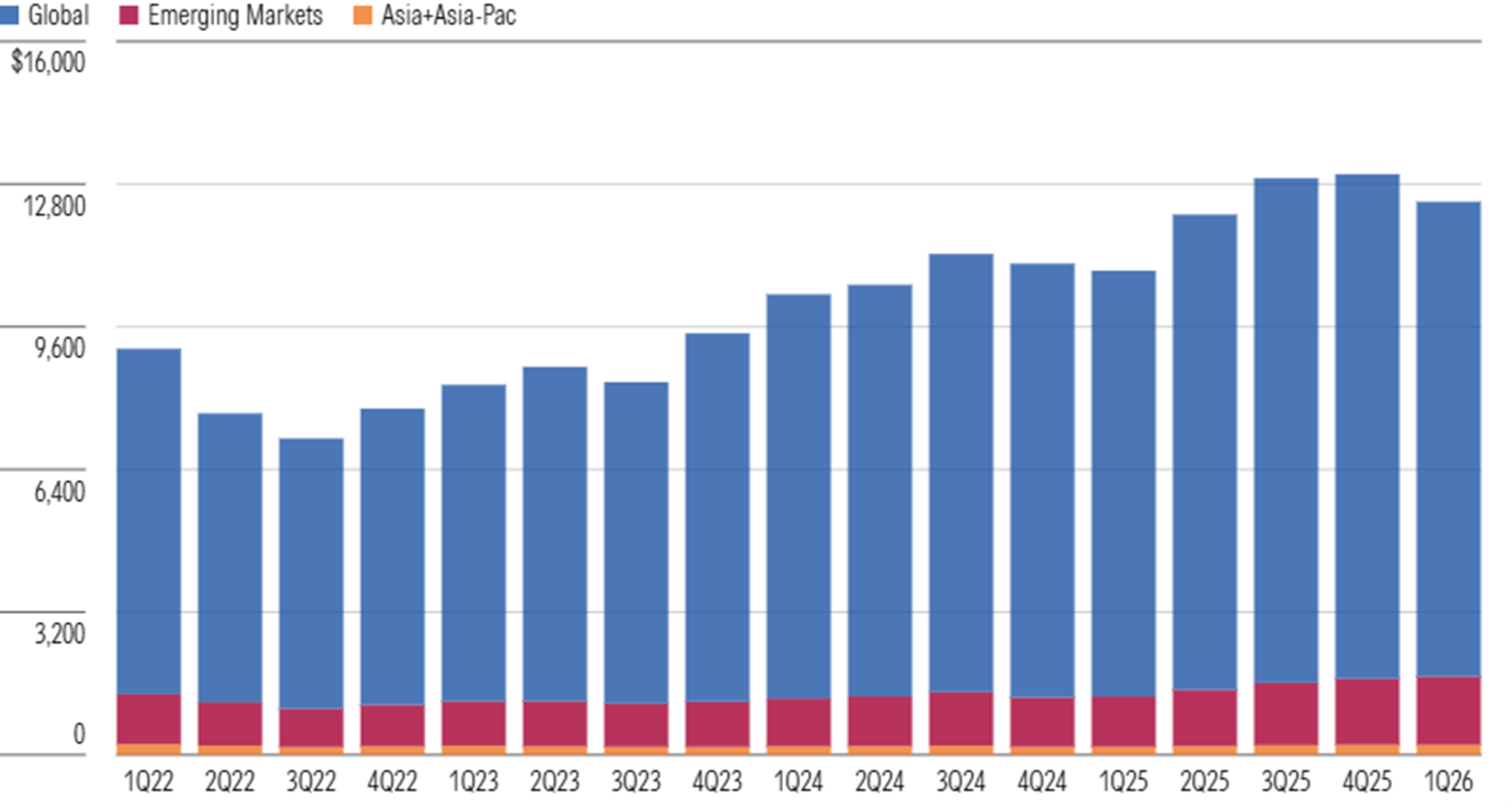
Beyond India-focused funds, regionally diversified funds with partial allocations to Indian equities represent another critical, and often under-appreciated, channel of foreign investment in Indian markets. This universe — comprising Asia/Asia-Pacific funds, emerging-market funds, and global funds — collectively managed an estimated USD 12.4 trillion in assets as of March 2026, down 4.7% from USD 13.0 trillion in December 2025.
Exhibit 4 Assets of Funds With Partial Allocations to India (USD Billions)
Source: Morningstar Direct. Data as of March 31, 2026. Note: Data includes funds with assets of more than USD 10 million as of March 2026.
The combined India allocation within this universe declined sharply, falling 16% to approximately USD 317 billion from USD 378 billion in the previous quarter. The decline was broad-based across all three fund categories.
The flow dynamics within this space were more differentiated, however. Global funds and emerging-market funds remained net buyers of Indian equities during the quarter — suggesting that portfolio rebalancing, rather than outright risk aversion, was driving their activity. As India's weight in major indices declined following the market correction, these funds likely added incrementally to maintain target allocations. Asia/Asia-Pacific funds, by contrast, turned net sellers, actively reducing their India exposure. This is a notable development and may reflect a relative preference shift within the Asia/Asia-Pacific region.
The trajectory of this segment is important to watch. Given the sheer size of regionally diversified funds, even marginal shifts in India's weight within these portfolios can translate into substantial flows into or out of Indian equity markets.
Looking Ahead
The quarter ended March 2026 marks a period of recalibration, not abandonment, for foreign investors in India. The structural case for India remains intact: steady economic growth, a large domestic consumption base, improving corporate balance sheets, and sustained government capital expenditure. Domestic institutional investors and retail participation held firm through the correction, providing crucial market support.
Near-term sentiment, however, will remain tethered to external developments. The trajectory of crude oil prices, the evolution of the geopolitical situation, global interest rate expectations, and the broader risk appetite toward emerging markets will collectively shape the pace of any recovery in foreign flows.